Mozilla

'Mozilla VPN' Launches in Six Countries (mozilla.org) 69

"Starting today, there's a VPN on the market from a company you trust," Mozilla announced Wednesday.

Mozilla VPN is now officially available for Windows and Android in six countries: the U.S., Canada, the U.K., Singapore, Malaysia, and New Zealand, and it'll be coming to even more countries later this year, reports the Verge: The service is available for $4.99 a month, and, like other VPNs, it's designed to make your web-browsing more private and secure. As part of the move, the service is being rebranded from Firefox Private Network to Mozilla VPN, a change that was announced last month.

Mozilla argues that its VPN service has a couple of advantages over its many competitors. It says it should offer a faster browsing experience in many cases because it's based on a protocol with less than a third of the lines of code of an average VPN service provider. The company is also banking on the reputation it's built up with its privacy-focused browser, and it adds that it only collects the information it needs to run a service and doesn't keep user data logs.

The VPN's launch follows beta trials in the US, which also included tests of a VPN built directly into the Firefox browser. Last month, Mozilla announced that it would be testing asking users to pay $2.99 a month for unlimited usage of the extension, which is designed to mask your traffic within the browser rather than at a system-wide level.

Programming

Are Whiteboard Coding Interviews Just Testing For Social Anxiety? (theregister.com) 196

An anonymous reader quotes The Register: People applying for software engineering positions at companies are often asked to solve problems on a whiteboard, under the watchful eye of an interviewer, as a way to assess technical problem solving skills. But recent research suggests that whiteboard technical tests — so daunting to job seekers that there are books on how to deal with them — often fail to assess technical skill, according to new research. Instead, they're all about pressure.

In a paper to be presented later this year at the ACM Joint European Software Engineering Conference and Symposium on the Foundations of Software Engineering, researchers from North Carolina State University and Microsoft in the U.S. argue that whiteboard sessions test for stage fright rather than, y'know, coding competency... "A technical interview has an uncanny resemblance to the Trier Social Stress Test, a procedure used for decades by psychologists and is the best known 'gold standard' procedure for the sole purpose of reliably inducing stress." As a consequence, whiteboard interviews may fail to assess coder competency. Rather, the researchers argue, they measure how well job candidates handle anxiety....

In essence, social anxiety took otherwise qualified job candidates out of the running because of the circumstances of the interview.

Twitter

Many New Details Emerge About Twitter's Breach (nytimes.com) 32

The New York Times claims to have traced the origins of a Twitter security breach to "a teasing message between two hackers late Tuesday on the online messaging platform Discord." [The Times' article was also republished here by the Bangkok Post.] "yoo bro," wrote a user named "Kirk," according to a screenshot of the conversation shared with The New York Times. "i work at twitter / don't show this to anyone / seriously." He then demonstrated that he could take control of valuable Twitter accounts — the sort of thing that would require insider access to the company's computer network. The hacker who received the message, using the screen name "lol," decided over the next 24 hours that Kirk did not actually work for Twitter because he was too willing to damage the company. But Kirk did have access to Twitter's most sensitive tools, which allowed him to take control of almost any Twitter account...

[F]our people who participated in the scheme spoke with The Times and shared numerous logs and screen shots of the conversations they had on Tuesday and Wednesday, demonstrating their involvement both before and after the hack became public. The interviews indicate that the attack was not the work of a single country like Russia or a sophisticated group of hackers. Instead, it was done by a group of young people — one of whom says he lives at home with his mother — who got to know one another because of their obsession with owning early or unusual screen names, particularly one letter or number, like @y or @6... "lol" did not confirm his real-world identity, but said he lived on the West Coast and was in his 20s. "ever so anxious" said he was 19 and lived in the south of England...

The group began by selling access to highly-coveted Twitter handles for bitcoin, according to the Times, including the accounts @dark, @w, @l, @50 and @vague.

Brian Krebs had suggested tweets of Twitter's internal tools came from "notorious SIM swapper" PlugWalkJoe — but the Times spoke to the 21-year-old (real name: Joseph O'Connor) who says his only involvement was taking possession of the breached Twitter account @6. "I don't care. They can come arrest me. I would laugh at them. I haven't done anything." Mr. O'Connor said other hackers had informed him that Kirk got access to the Twitter credentials when he found a way into Twitter's internal Slack messaging channel and saw them posted there, along with a service that gave him access to the company's servers. People investigating the case said that was consistent with what they had learned so far.
Meanwhile, Twitter has said, "The attackers successfully manipulated a small number of employees and used their credentials to access Twitter's internal systems, including getting through our two-factor protections. As of now, we know that they accessed tools only available to our internal support teams."

But Mashable brings more bad news: In an update posted on Friday night, Twitter ran down what its internal investigation has discovered so far. One piece of previously unknown information: the hacker(s) downloaded the personal account data for up to eight of the accounts which they had access to.

I should make this clear up front: that data includes direct messages...

As rumors spread around the platform as to which eight accounts could have been targeted, Twitter released an additional clarification... "[T]o address some of the speculation: none of the eight were Verified accounts..." Twitter also says 130 Twitter accounts were targeted... The company said that hackers gained access to 45 of them via a password reset and, for a second time, reiterated that the passwords used on the accounts were not accessed.

An article shared by Slashdot reader kimmmos notes that one account that went untouched was that of U.S. president Donald Trump. The Verge reports "it could be because Twitter has implemented extra protections for his account." But responding to the other account breaches, "A Twitter spokesperson confirmed the company has been in touch with the FBI," reports CNN. "We're acutely aware of our responsibilities to the people who use our service and to society more generally," Twitter added in a blog post.

"We're embarrassed, we're disappointed, and more than anything, we're sorry."
Businesses

Could Working Remotely Kill Silicon Valley's Culture? (medium.com) 67

This week Medium's editor-at-large argued remote working could kill Silicon Valley in a new article on Medium's business site "Marker" — because working remotely could bring an end to those "serendipitous encounters" which lead to blockbuster products: Tech serendipity is the means to an end in Silicon Valley. "You bring together a density of entrepreneurs and capital with a belief in crazy ideas and a readiness to fund them, and you manufacture serendipity at higher rates than if it were evenly distributed," said Shaan Hathiramani, the CEO of Flockjay, a San Francisco education startup, who is among those wrestling with how to replicate the chance encounter. But in a future remote dispersion of workers that all but excludes the unexpected, face-to-face encounter, what will Silicon Valley lose...?

Dozens of startups and legacy companies are trying to solve the serendipity crisis. Among them are Gather, a Silicon Valley startup, and Hopin, a U.K. company, both of which see the answer in conference apps: You watch online talks, then — just as you would at a physical conference — you go onto a "coffee break," a virtual room where you can "bump into" just about anyone else at the event. You can also sign up to be paired with people with whom you might have similar interests. "It's like a coffee break at TED," said Paul Saffo, a futurist at Stanford. Last week, Microsoft released a new feature for its Teams conferencing app called "Together Mode," which uses A.I. to cut out the images of everyone in a call and assemble them in a virtual setting, such as a theater. The sensation is to remove some of the fake-togetherness of Zoom calls, which is a real advance for the typical work meeting...

If the past is instructive, the pandemic will pass and many daily routines will return. Hordes of people will return to the office, but large numbers won't. Some will pick up and move. At that point, today's effort to digitalize serendipity will pick up more urgency. Video conferencing and other software will get better, and some companies will claim their product fosters the unscripted moment in truly innovative ways, blind to demographics. The question is whether that solution will include a continued place for Silicon Valley.

Security

VPN With 'Strict No-Logs Policy' Exposed Millions of User Log Files (betanews.com) 86

New submitter kimmmos shares a report from BetaNews: An unprotected database belonging to the VPN service UFO VPN was exposed online for more than two weeks. Contained within the database were more than 20 million logs including user passwords stored in plain text. User of both UFO VPN free and paid services are affected by the data breach which was discovered by the security research team at Comparitech. Despite the Hong Kong-based VPN provider claiming to have a "strict no-logs policy" and that any data collected is anonymized, Comparitech says that "based on the contents of the database, users' information does not appear to be anonymous at all." A total of 894GB of data was exposed, and the API access records and user logs included: Account passwords in plain text; VPN session secrets and tokens; IP addresses of both user devices and the VPN servers they connected to; Connection timestamps; Geo-tags; Device and OS characteristics; and URLs that appear to be domains from which advertisements are injected into free users' web browsers. Comparitech notes that this runs counter to UFO VPN's privacy policy.
Communications

FCC: Phone Carriers That Profit From Robocalls Could Have All Calls Blocked (arstechnica.com) 55

"Bad-actor" phone companies that profit from robocalls could be blocked by more legitimate carriers under rules approved unanimously yesterday by the Federal Communications Commission. From a report: Under the change, the FCC said carriers can block calls "from bad-actor upstream voice service providers that pass illegal or unwanted calls along to other providers, when those upstream providers have been notified but fail to take action to stop these calls." Carriers that impose this type of blocking will get a safe harbor from liability "for the unintended or inadvertent blocking of wanted calls, thus eliminating a concern that kept some companies from implementing robust robocall blocking efforts."

This expanded level of blocking -- spurred by a new law in which Congress directed the FCC to expand safe harbors -- could be implemented by companies that sell phone service directly to consumers. That includes mobile carriers Verizon, AT&T, and T-Mobile, traditional landline companies, and VoIP providers. Carriers won't be able to block calls from just any provider. As Chairman Ajit Pai explained, the safe harbor will be available in cases when the "bad-actor" telecom has been notified by the FCC that it is carrying illegal traffic and "fails either to effectively mitigate such traffic or to implement effective measures to prevent customers from using its network to originate illegal calls."

Medicine

Russian Hackers Are Linked To Sweeping Bid To Steal Vaccine Data (bloomberg.com) 69

Russian state intelligence is hacking international research centers that are racing to develop a Covid-19 vaccine, the U.K., U.S. and Canadian governments said. From a report: It is unclear whether research facilities have been damaged or if the vaccine programs have been set back as a result of the hacks but officials warned that the cyber attacks are ongoing. In a dramatic statement on Thursday, Britain's National Cyber Security Centre (NCSC) said vaccine and therapeutic sectors in multiple countries have been targeted by a group known as APT29, which it said is "almost certainly" part of Russian state intelligence. Security agencies in the U.S. and Canada later issued their own statements backing up the findings. "It is completely unacceptable that the Russian intelligence services are targeting those working to combat the coronavirus pandemic," British Foreign Secretary Dominic Raab said. "While others pursue their selfish interests with reckless behavior, the U.K. and its allies are getting on with the hard work of finding a vaccine and protecting global health."
Firefox

Firefox Working on Fixing a One-Year-Old Bug in Its Android App That Keeps Camera Active After Users Have Minimized the App or Locked Their Phone (zdnet.com) 18

Mozilla says it's working on fixing a bug in Firefox for Android that keeps the smartphone camera active even after users have moved the browser in the background or the phone screen was locked. From a report: A Mozilla spokesperson told ZDNet in an email this week that a fix is expected for later this year in October. The bug was first spotted and reported to Mozilla a year ago, in July 2019, by an employee of video delivery platform Appear TV. The bug manifests when users chose to video stream from a website loaded in Firefox instead of a native app. Mobile users often choose to stream from a mobile browser for privacy reasons, such as not wanting to install an intrusive app and grant it unfettered access to their smartphone's data. Mobile browsers are better because they prevent websites from accessing smartphone data, keeping their data collection to a minimum. The Appear TV developer noticed that Firefox video streams kept going, even in situations when they should have normally stopped.
Security

Iranian Spies Accidentally Leaked Videos of Themselves Hacking (wired.com) 41

An anonymous reader quotes a report from Wired: Researchers at IBM's X-Force security team revealed today that they've obtained roughly five hours of video footage that appears to have been recorded directly from the screens of hackers working for a group IBM calls ITG18, and which other security firms refer to as APT35 or Charming Kitten. It's one of the most active state-sponsored espionage teams linked to the government of Iran. The leaked videos were found among 40 gigabytes of data that the hackers had apparently stolen from victim accounts, including U.S. and Greek military personnel. Other clues in the data suggest that the hackers targeted U.S. State Department staff and an unnamed Iranian-American philanthropist.

The IBM researchers say they found the videos exposed due to a misconfiguration of security settings on a virtual private cloud server they'd observed in previous APT35 activity. The files were all uploaded to the exposed server over a few days in May, just as IBM was monitoring the machine. The videos appear to be training demonstrations the Iran-backed hackers made to show junior team members how to handle hacked accounts. They show the hackers accessing compromised Gmail and Yahoo Mail accounts to download their contents, as well as exfiltrating other Google-hosted data from victims. This sort of data exfiltration and management of hacked accounts is hardly sophisticated hacking. It's more the kind of labor-intensive but relatively simple work that's necessary in a large-scale phishing operation. But the videos nonetheless represent a rare artifact, showing a first-hand view of state-sponsored cyberspying that's almost never seen outside of an intelligence agency.

Security

Who's Behind Wednesday's Epic Twitter Hack? (krebsonsecurity.com) 75

Brian Krebs has written a blog post with clues about who may have been behind yesterday's Twitter hack, which had some of the world's most recognizable public figures tweeting out links to bitcoin scams. An anonymous reader shares an excerpt from the report (though we strongly recommend you read the full analysis here): There are strong indications that this attack was perpetrated by individuals who've traditionally specialized in hijacking social media accounts via "SIM swapping," an increasingly rampant form of crime that involves bribing, hacking or coercing employees at mobile phone and social media companies into providing access to a target's account. In the days leading up to Wednesday's attack on Twitter, there were signs that some actors in the SIM swapping community were selling the ability to change an email address tied to any Twitter account. In a post on OGusers -- a forum dedicated to account hijacking -- a user named "Chaewon" advertised they could change email address tied to any Twitter account for $250, and provide direct access to accounts for between $2,000 and $3,000 apiece. "This is NOT a method, you will be given a full refund if for any reason you aren't given the email/@, however if it is revered/suspended I will not be held accountable," Chaewon wrote in their sales thread, which was titled "Pulling email for any Twitter/Taking Requests."

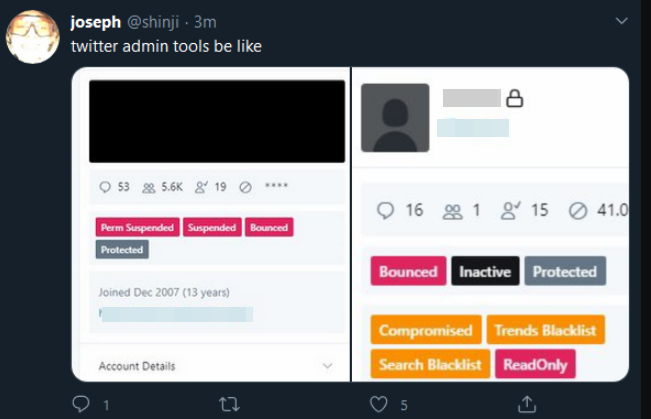
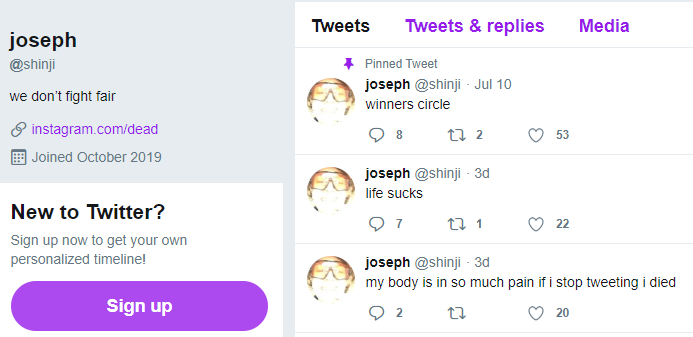
Hours before any of the Twitter accounts for cryptocurrency platforms or public figures began blasting out bitcoin scams on Wednesday, the attackers appear to have focused their attention on hijacking a handful of OG accounts, including "@6." That Twitter account was formerly owned by Adrian Lamo -- the now-deceased "homeless hacker" perhaps best known for breaking into the New York Times's network and for reporting Chelsea Manning's theft of classified documents. @6 is now controlled by Lamo's longtime friend, a security researcher and phone phreaker who asked to be identified in this story only by his Twitter nickname, "Lucky225."[...] But around the same time @6 was hijacked, another OG account -- @B -- was swiped. Someone then began tweeting out pictures of Twitter's internal tools panel showing the @B account. Another Twitter account -- @shinji -- also was tweeting out screenshots of Twitter's internal tools. Minutes before Twitter terminated the @shinji account, it was seen publishing a tweet saying "follow @6," referring to the account hijacked from Lucky225.

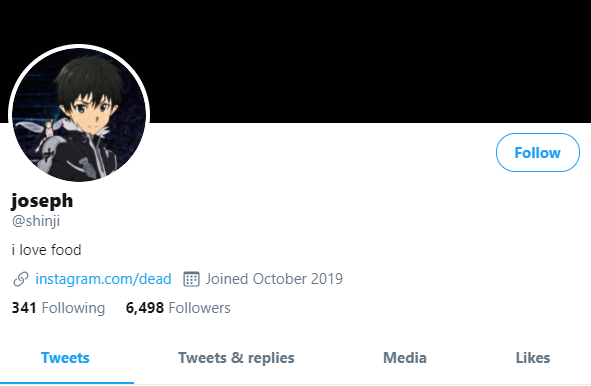
Cached copies of @Shinji's tweets prior to Wednesday's attack on Twitter are available here and here from the Internet Archive. Those caches show Shinji claims ownership of two OG accounts on Instagram -- "j0e" and "dead." KrebsOnSecurity heard from a source who works in security at one of the largest U.S.-based mobile carriers, who said the "j0e" and "dead" Instagram accounts are tied to a notorious SIM swapper who goes by the nickname "PlugWalkJoe." Investigators have been tracking PlugWalkJoe because he is thought to have been involved in multiple SIM swapping attacks over the years that preceded high-dollar bitcoin heists. Now look at the profile image in the other Archive.org index of the @shinji Twitter account (pictured below). It is the same image as the one included in the @Shinji screenshot above from Wednesday in which Joseph/@Shinji was tweeting out pictures of Twitter's internal tools.

This individual, the source said, was a key participant in a group of SIM swappers that adopted the nickname "ChucklingSquad," and was thought to be behind the hijacking of Twitter CEO Jack Dorsey's Twitter account last year. The mobile industry security source told KrebsOnSecurity that PlugWalkJoe in real life is a 21-year-old from Liverpool, U.K. named Joseph James Connor. The source said PlugWalkJoe is in Spain where he was attending a university until earlier this year. He added that PlugWalkJoe has been unable to return home on account of travel restrictions due to the COVID-19 pandemic. [...] If PlugWalkJoe was in fact pivotal to this Twitter compromise, it's perhaps fitting that he was identified in part via social engineering.

IBM

IBM Job Ad Calls For a Minimum 12 Years' Experience With Kubernetes -- Which is Six Years Old (theregister.com) 42

IBM's Global Technology Services has posted a job ad calling for candidates with a "minimum 12+ years' experience in Kubernetes administration and management." From a report: Which is a little odd because the first GitHub commit for the project was made on June 7, 2014. And the feature freeze for version 1.0 was announced on May 22, 2015. Sharp-minded Reg readers will have recognised that -- absent time travel -- it is therefore not possible for anyone to have 12 years' experience with Kubernetes. The ad is sadly silent on just how IBM expects candidates will have found the time to accumulate a dozen years' experience in a six-year-old project.
Security

Microsoft Warns of a 17-Year-Old 'Wormable' Bug (wired.com) 9

Since WannaCry and NotPetya struck the internet just over three years ago, the security industry has scrutinized every new Windows bug that could be used to create a similar world-shaking worm. Now one potentially "wormable" vulnerability -- meaning an attack can spread from one machine to another with no human interaction -- has appeared in Microsoft's implementation of the domain name system protocol, one of the fundamental building blocks of the internet. From a report: As part of its Patch Tuesday batch of software updates, Microsoft today released a fix for a bug discovered by Israeli security firm Check Point, which the company's researchers have named SigRed. The SigRed bug exploits Windows DNS, one of the most popular kinds of DNS software that translates domain names into IP addresses. Windows DNS runs on the DNS servers of practically every small and medium-sized organization around the world. The bug, Check Point says, has existed in that software for a remarkable 17 years. Check Point and Microsoft warn that the flaw is critical, a 10 out of 10 on the common vulnerability scoring system, an industry standard severity rating. Not only is the bug wormable, Windows DNS software often runs on the powerful servers known as domain controllers that set the rules for networks. Many of those machines are particularly sensitive; a foothold in one would allow further penetration into other devices inside an organization.

On top of all of that, says Check Point's head of vulnerability research Omri Herscovici, the Windows DNS bug can in some cases be exploited with no action on the part of the target user, creating a seamless and powerful attack. "It requires no interaction. And not only that, once you're inside the domain controller that runs the Windows DNS server, expanding your control to the rest of the network is really easy," says Omri Herscovici. "It's basically game over." Check Point found the SigRed vulnerability in the part of Windows DNS that handles a certain piece of data that's part of the key exchange used in the more secure version of DNS known as DNSSEC. That one piece of data can be maliciously crafted such that Windows DNS allows a hacker to overwrite chunks of memory they're not meant to have access to, ultimately gaining full remote code execution on the target server. (Check Point says Microsoft asked the company not to publicize too many details of other elements of the technique, including how it bypasses certain security features on Windows servers.)

Security

Israeli Court Rules NSO Group Can Continue Exporting Spyware (vice.com) 39

The infamous spyware company NSO Group scored a major win in what critics are calling a "disgraceful ruling" in an Israeli court this week. From a report: The court ruled that NSO can keep exporting its hacking and surveillance tools, arguing that the human rights organization Amnesty International, which had sued the company in an attempt to block its exports, failed to prove that an NSO customer used its technology to spy on Amnesty staff. In 2018, as Motherboard reported at the time, Amnesty claimed to have found hackers spying on one of the organization's researchers using NSO spyware. After the incident, the organization sued NSO in Israel in an attempt to block the export of its surveillance technology. A Tel Aviv District Court judge dismissed the suit alleging Amnesty did not present enough evidence, and said Israel's Defence Ministry, which is tasked with overseeing the export of surveillance technologies, has the right safeguards in place to protect human rights.
Microsoft

Microsoft Adds Support For Custom '+' Email Addresses in Office 365 (zdnet.com) 74

Microsoft is adding support for custom email addressing to Office 365 email services, a feature it hopes to complete in Q3 2020. From a report: Custom email addresses are an optional feature that some email providers can support. The feature is described in the RFC 5233 internet standard. Officially known as subaddressing, this standard allows users to extend their email address using "tags" or the plus (+) character, hence its two alternative names of tagged addressing or plus addressing. For example, a user with the email address of username@domain.com can use the plus addressing feature to extend their email address to username+tag@domain.com. If the user's email address supports subaddressing, all emails sent to the username+tag@domain.com email will land in the user's username@domain.com inbox.
Encryption

Enigma Code-Breaking Machine Rebuilt At Cambridge (techxplore.com) 34

Cambridge Engineering alumnus Hal Evans has built a fully-functioning replica of a 1930s Polish cyclometer -- an electromechanical cryptologic device that was designed to assist in the decryption of German Enigma ciphertext. The replica currently resides in King's College, Cambridge. TechXplore reports: Work on the hardware-based replica began in 2018, as part of Hal's fourth year Master's project under the supervision of King's College Fellow and Senior Tutor Dr. Tim Flack. The aim was to investigate further into cryptologist Marian Rejewski's cyclometer -- an early forerunner to Cambridge University mathematician Alan Turing's machine, known as the Bombe, which was used to crack the German Enigma code during the Second World War. Hal said he chose to work on the cyclometer as it was the very first machine used to assist the decryption effort. To his knowledge, the replica is the first fully-functioning hardware-based electromechanical cyclometer to exist since the years preceding the Second World War. The original machines would have been destroyed in 1939 to prevent them from falling into the hands of German invaders.

Rejewski's cyclometer exploited the German's procedure at the time of double encipherment of the Enigma message key, and semi-automated the process for calculating what were known as 'characteristics' for every possible Enigma rotor starting position. There were more than 100,000 of these rotor starting positions, and they each needed their characteristic to be calculated and catalogued in a card index system. The cyclometer therefore eliminated the arduous task of calculating these characteristics by hand. The machine consisted of, in effect, two interlinked Enigma systems side-by-side -- one offset by three positions relative to the other -- and 26 lamps and switches to cover the alphabet. On operation, a certain number of bulbs illuminated, indicating the lengths of the characteristics. These were recorded for every single possible rotor starting position to create an immense look-up catalogue. Once this was completed, obtaining the daily Enigma rotor starting settings to decode messages was a simple matter of intercepting enough messages and referencing the catalogue, taking only a matter of minutes.

Security

US Threatens To Restrict WeChat Following TikTok Backlash (techcrunch.com) 36

Amid intense scrutiny over TikTok as a potential national security risk in the U.S., WeChat, the essential tool for Chinese people's day-to-day life, is also taking heat from Washington. TechCrunch reports: White House trade advisor Peter Navarro told Fox Business on Sunday that "[TikTok] and WeChat are the biggest forms of censorship on the Chinese mainland, and so expect strong action on that." Navarro alleged that "all of the data that goes into those mobile apps that kids have so much fun with and seem so convenient, it goes right to servers in China, right to the Chinese military, the Chinese communist party, and the agencies which want to steal our intellectual property."

It's unclear how the U.S. restriction will play out, if it will at all, though some WeChat users are already speculating workarounds to stay in touch with their family and friends back home. In the case that the Tencent-owned messenger is removed by Apple App Store or Google Play, U.S.-based users could switch to another regional store to download the app. If it were an IP address ban, they could potentially access the app through virtual private networks (VPNs), tools that are familiar to many in China to access online services blocked by Beijing's Great Firewall.

Google

Microsoft Worked With Google To Bring Progressive Web Apps To the Play Store (thurrott.com) 42

Microsoft has been collaborating with Google to ensure that their tools interoperate and can help developers get their Progressive Web Apps (PWAs) into the Play Store. From a report: "We're glad to announce a new collaboration between Microsoft and Google for the benefit of the web developer community," Microsoft's Judah Gabriel Himango announced. "Microsoft's PWABuilder and Google's Bubblewrap are now working together to help developers publish PWAs in the Google Play Store." As Himango explains, PWABuilder is a Microsoft tool that helps developers build PWAs from existing websites and publish them in app stores, while Bubblewrap is a Google tool and library used to generate and sign Google Play Store packages from PWAs. After months of collaboration, the two firms have made some interesting progress towards integrating the tools. Now, PWABuilder utilizes Bubblewrap "under the hood," as Himango puts it, allowing developers to package PWAs for the Play Store with PWABuilder that support the new web shortcuts standard. (On Windows 10, web shortcuts appear as jump lists.)
Security

US Secret Service Creates New Cyber Fraud Task Force (bleepingcomputer.com) 28

The U.S. Secret Service announced the creation of the Cyber Fraud Task Force (CFTF) after the merger of its Financial Crimes Task Forces (FCTFs) and Electronic Crimes Task Forces (ECTFs) into a single unified network. Bleeping Computer reports: CFTF's main goal is to investigate and defend American individuals and businesses from a wide range of cyber-enabled financial crimes, from business email compromise (BEC) scams and ransomware attacks to data breaches and the illegal sale of stolen personal information and credit cards on the Internet and the dark web. Consolidating the two task forces into CFTF will allow the Secret Service to boost its agents' ability to prevent, detect, and mitigate financially-motivated cybercrime by improving coordination, sharing of resources and expertise, and best practices dissemination.

"The creation of the new Cyber Fraud Task Force (CFTF), will offer a specialized cadre of agents and analysts, trained in the latest analytical techniques and equipped with the most cutting-edge technologies," said Michael D'Ambrosio, U.S. Secret Service Assistant Director. At the moment, the Secret Service has already operationalized CFTFs in 42 domestic offices and in 2 international locations (London and Rome). The Department of Homeland Security federal law enforcement agency also plans to increase the number of CFTF locations through its network of more than 160 offices across the U.S. and around the globe.

Encryption

Signal's New PIN Feature Worries Cybersecurity Experts (vice.com) 45

Lorenzo Franceschi-Bicchierai, writing for Vice: Ever since NSA leaker Edward Snowden said "use Signal, use Tor," the end-to-end encrypted chat app has been a favorite of people who care about privacy and need a chat and calling app that is hard to spy on. One of the reasons security experts recommended Signal is because the app's developers collected -- and thus retained -- almost no information about its users. This means that, if subpoenaed by law enforcement, Signal would have essentially nothing to turn over. Signal demonstrated this in 2016, when it was subpoenaed by a court in Virginia. But a newly added feature that allows users to recover certain data, such as contacts, profile information, settings, and blocked users, has led some high-profile security experts to criticize the app's developers and threaten to stop using it.

Signal will store that data on servers the company owns, protected by a PIN that the app has initially been asking users to add, and then forced them to. The purpose of using a PIN is, in the near future, to allow Signal users to be identified by a username, as opposed to their phone number, as Signal founder Moxie Marlinspike explained on Twitter (as we've written before, this is a laudable goal; tying Signal to a phone number has its own privacy and security implications). But this also means that unlike in the past, Signal now retains certain user data, something that many cybersecurity and cryptography experts see as too dangerous. Matthew Green, a cryptographer and computer science professor at Johns Hopkins University, said that this was "the wrong decision," and that forcing users to create a PIN and use this feature would force him to stop using the app.

Portables (Apple)

Apple Advises Against MacBook Camera Covers Due To Display Cracking (appleinsider.com) 126

Apple, in a new support document, is warning users against closing their MacBook lids with a cover over the camera. From a report: Placing a cover, sticker or tape over a laptop camera is a practice adopted by some privacy- and security-conscious individuals to protect against webcam hijacking. Now, however, Apple is explicitly advising against the tactic. In a support document published earlier in July, Apple urges users not to close their MacBook Pro or MacBook Air lids if there's a camera cover installed on it. "If you close your Mac notebook with a camera cover installed, you might damage your display because the clearance between the display and keyboard is designed to very tight tolerances," Apple notes. The support document also outlines some of the privacy and security functions of the camera, including the green indicator light that lets users know when the camera is active and the camera permission settings introduced in macOS Mojave.

Slashdot Top Deals